

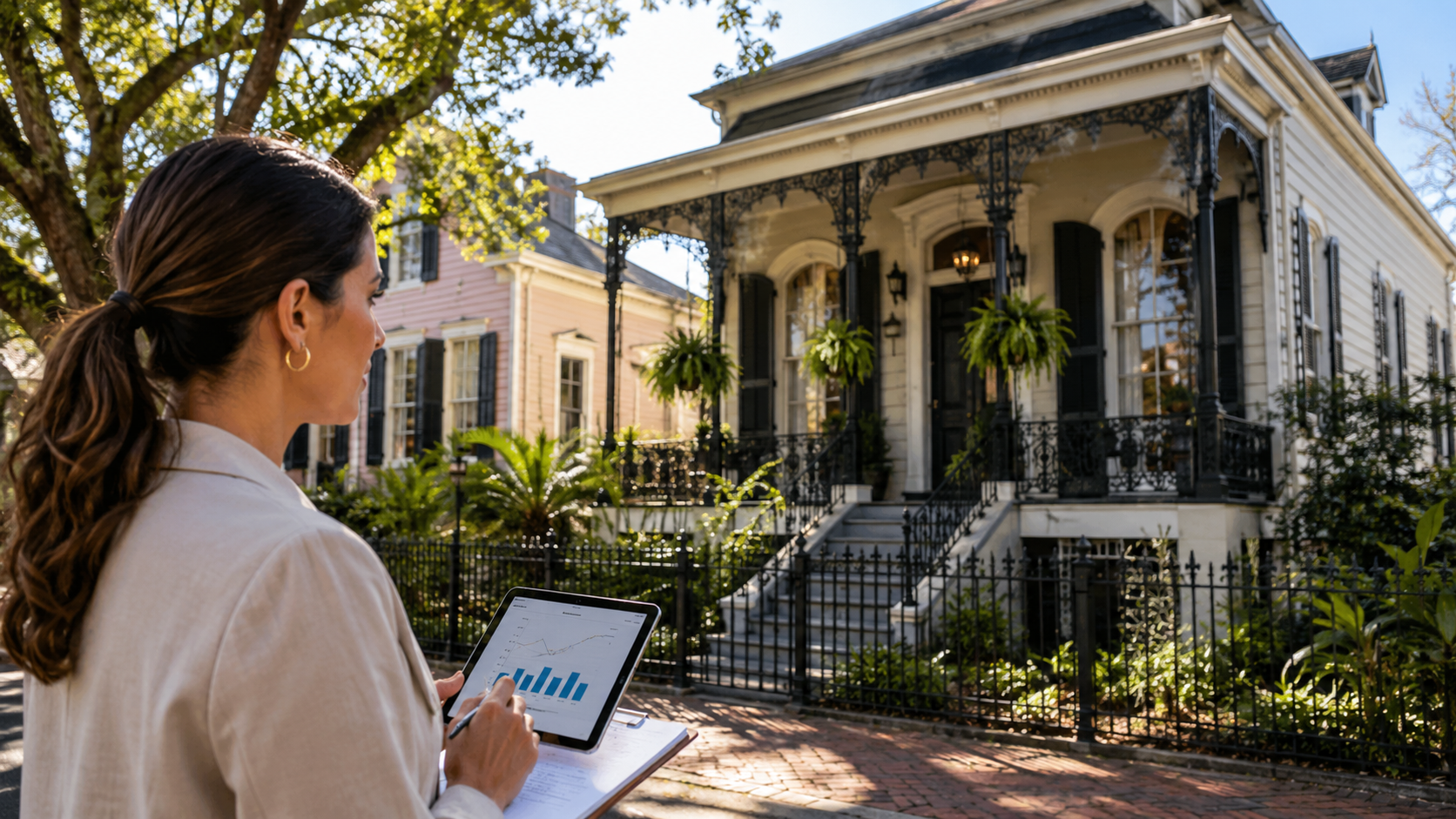
A home can look perfectly priced on an online estimate and still miss the market by tens of thousands of dollars. This home valuation accuracy example shows why that happens in New Orleans, where a property's exact block, elevation, renovation quality, and architectural character can matter as much as its bedroom count.
For sellers, the difference is consequential. Price too high and a listing can lose momentum during its most visible days. Price too low and strong demand may help, but there is no guarantee that the market will fully close the gap. A thoughtful valuation creates the confidence to make a strategic decision rather than simply choose a number that feels good.
A Home Valuation Accuracy Example for a New Orleans Seller
Consider a fictional home in Uptown New Orleans: a raised, early 20th-century residence with 2,480 square feet, four bedrooms, three and a half baths, a renovated kitchen, off-street parking, and a 5,000-square-foot lot. It sits on a quiet, well-kept block near neighborhood amenities, but it does not have a pool or a detached guest suite.
An automated valuation tool places the home at $925,000. That estimate may be a reasonable starting point, but it is not yet a pricing strategy. The tool has likely recognized the home's size, broad location, recent area sales, and public-record details. What it cannot reliably judge is whether the kitchen renovation is current and cohesive, whether the floors and millwork are exceptionally preserved, or whether a buyer will see the home as move-in ready compared with its active competition.
A local comparative market analysis identifies three recent sales that provide more useful context. The first sold for $930,000. It was slightly smaller at 2,420 square feet, similarly renovated, and on a comparable interior block, but it included a garage. The second sold for $875,000. It was larger, though its kitchen and baths were dated and it faced a busier street. The third sold for $1,005,000. It had a polished renovation, a pool, and a more substantial outdoor entertaining area.
None of those homes is an exact match, and that is the point. Accurate valuation is not about finding one sale and copying its price. It is about weighing each sale according to its similarities, differences, timing, and buyer appeal.
After accounting for condition, location, amenities, and current demand, the likely value range for the subject property may be closer to $945,000 to $970,000. A seller might choose to list at $959,000, assuming the home is prepared, professionally presented, and introduced during an appropriate market window. That is materially different from relying on the $925,000 automated estimate alone.
Why Online Estimates Can Miss the Mark
Automated valuation models are useful for broad orientation. They can help homeowners monitor market movement or begin a conversation about equity. Their limitation is that public data does not capture the full story of a distinctive property.
This is especially true in New Orleans. Two homes with the same square footage can command very different prices when one is on a preferred block, offers off-street parking, has a more flexible floor plan, or has been restored with care. A computer model may see comparable tax records. A buyer sees light, ceiling height, storage, finishes, outdoor space, and the feeling of arriving home.
An online estimate can also lag behind the market. If recent sales reflect contracts negotiated months earlier, the number may not fully account for changing inventory, mortgage-rate shifts, or a surge in demand for a particular neighborhood or condominium building. It is a data point, not a final answer.
Comparable Sales Matter More Than Price Per Square Foot
Price per square foot is one of the most commonly cited valuation metrics, and one of the easiest to misuse. It offers a quick shorthand, but it cannot independently value a historic cottage, a French Quarter condominium, or a renovated family home near Audubon Park.
A well-selected comparable should be geographically relevant, recently sold, and similar in property type, age, condition, and buyer profile. A luxury condominium should generally be measured against sales in the same building or a closely competitive building, not against a larger single-family home several blocks away. Likewise, a renovated Victorian needs comparison to homes that attract a similar buyer, not merely properties with matching square footage.
The strongest analysis also considers active and pending listings. Closed sales tell us what buyers paid. Active listings reveal the seller competition a property will face today. Pending properties can offer a timely signal of where buyers are writing offers, although their final sale prices are not yet public.
New Orleans Details That Can Change Value
New Orleans real estate rewards local judgment because the market is highly specific. Neighborhood boundaries are meaningful, but so are smaller distinctions within them. One side of a major avenue, a quieter block, proximity to a beloved commercial corridor, or access to a preferred school area can influence buyer interest.
Flood zone, elevation, drainage history, and insurance costs deserve careful consideration as well. These factors do not automatically define a home's value, but they can affect affordability, buyer confidence, and the pool of potential purchasers. A valuation should look beyond a flood-zone label and consider the property's actual history, elevation documentation where available, and the practical insurance picture a buyer may encounter.
Condition is equally nuanced. Original architectural details can add tremendous appeal when they are well maintained and paired with functional updates. At the same time, a historic home with deferred maintenance may require a meaningful adjustment, even if its bones and location are exceptional. Buyers often price the inconvenience and uncertainty of future work into their offers.
Condominiums require another level of review. Monthly association dues, reserve funding, building insurance, rental restrictions, parking, amenities, and the number of competing units can all influence value. A unit with a beautiful interior may still be affected by broader building considerations, while a well-managed building can support stronger buyer confidence.
How to Get a More Reliable Value Range
A useful home valuation begins with complete, current information. Share details that public records may miss: the age of major systems, permits, renovations, roof updates, parking improvements, outdoor enhancements, and any work that has improved function or efficiency. Photographs and receipts can help establish the quality and scope of major updates.
Then, evaluate the home in its present market context. The goal is not to produce a single number with false precision. It is to establish a credible range, identify the factors that could move value toward the top or bottom of that range, and choose a pricing approach that matches the seller's timing and priorities.
For a seller who needs a quick, low-friction sale, a sharper price may be appropriate. For a special property with limited competition, a more patient strategy can make sense. The right approach depends on demand, condition, presentation, and the seller's next move.
The Question Behind Every Valuation
Most homeowners are not simply asking, What is my home worth? They are asking whether they can confidently buy their next home, fund a renovation, manage an inherited property, or make a move without leaving money behind.
That is why a valuation should come with context and a clear plan. Raymond Real Estate approaches pricing as part of a broader client experience: local market knowledge, polished positioning, and attentive guidance from the first conversation through closing.
Before you make a decision based on an estimate, ask for an analysis that accounts for how buyers will actually compare your home. The most valuable number is the one that helps you move forward with clarity.
Frequently Asked Questions About Home Valuations in New Orleans
What is a home valuation?
A home valuation is an estimate of what your property may sell for in the current real estate market. It is typically based on recent comparable sales, the home’s condition, location, size, features, and current buyer demand.
How is a New Orleans home’s value determined?
A local real estate professional will review recently sold homes with similar characteristics, including square footage, bedroom and bathroom count, architectural style, condition, lot size, parking, renovations, and neighborhood location. New Orleans-specific factors, such as flood zone, insurance costs, historic district regulations, and previous storm damage, may also influence value.
Are online home-value estimates accurate?
Online estimates can provide a general starting point, but they may not account for renovations, deferred maintenance, historic details, street-by-street differences, insurance considerations, or the condition of comparable properties. In New Orleans, two homes located only a few blocks apart can have substantially different market values.
What is the difference between a home valuation and an appraisal?
A comparative market analysis or broker price opinion estimates a home’s likely market value based on current sales activity. A licensed appraisal is a formal valuation commonly required by a mortgage lender. Sellers usually begin with a real estate professional’s valuation when deciding on a listing price.
How much does a home valuation cost?
Many New Orleans real estate agents offer a complimentary home valuation to prospective sellers. A formal appraisal completed by a licensed appraiser generally requires a separate fee.
Does my home’s flood zone affect its value?
Flood-zone classification can affect buyer demand, insurance costs, financing, and overall marketability. Buyers may also consider the home’s elevation, flood history, drainage, and whether an assumable flood insurance policy is available.
Do renovations always increase a home’s value?
Renovations can increase value, but homeowners do not always recover the full cost of every improvement. Updated kitchens, bathrooms, roofing, electrical systems, plumbing, HVAC systems, and energy-efficient features may appeal to buyers. The quality of the work and whether renovations were properly permitted can also affect value.
Do original architectural features add value?
Original hardwood floors, fireplaces, millwork, transoms, high ceilings, balconies, and other historic details can add character and buyer appeal. However, their impact on value depends on their condition, functionality, and the expectations of buyers in that particular neighborhood.
How does homeowners insurance affect property value in New Orleans?
Insurance availability and cost have become important considerations for local buyers. A property with a newer roof, updated electrical system, documented improvements, and favorable insurance history may be easier to insure and more attractive than a similar property with unresolved maintenance issues.
Does the neighborhood matter more than square footage?
Location is one of the most important factors in a home valuation. Walkability, nearby restaurants, schools, parks, transportation, parking, neighborhood demand, and proximity to amenities can all affect value. A smaller home in a highly desirable location may sell for more per square foot than a larger home elsewhere.
How often should I check my home’s value?
It can be helpful to request an updated valuation annually, before making major renovations, when reviewing your financial goals, or when considering selling. New Orleans real estate conditions can vary significantly by neighborhood and property type.
What should I do before requesting a home valuation?
Gather information about renovations, roof age, HVAC systems, insurance claims, permits, warranties, elevation certificates, and recent repairs. These details can help your real estate professional provide a more informed valuation.
Can I increase my home’s value before selling?
Repairs, fresh paint, landscaping, decluttering, professional cleaning, improved lighting, and addressing deferred maintenance may improve buyer perception. A local real estate professional can help identify which improvements are most likely to provide a return in your specific neighborhood.
How accurate is a real estate agent’s home valuation?
Accuracy depends on the quality of the comparable sales, the agent’s local market knowledge, and the information available about the property. An experienced New Orleans real estate professional should evaluate the home’s condition, location, features, competition, and recent neighborhood sales rather than relying only on automated data.
How can I find out what my New Orleans home is worth?
The best starting point is a personalized valuation from a local real estate professional who understands New Orleans neighborhoods, architecture, insurance considerations, and current buyer demand. A property-specific analysis can provide a more realistic estimate than a general online calculator.
For a property specific analysis, Contact Us Today
Check out this article next