

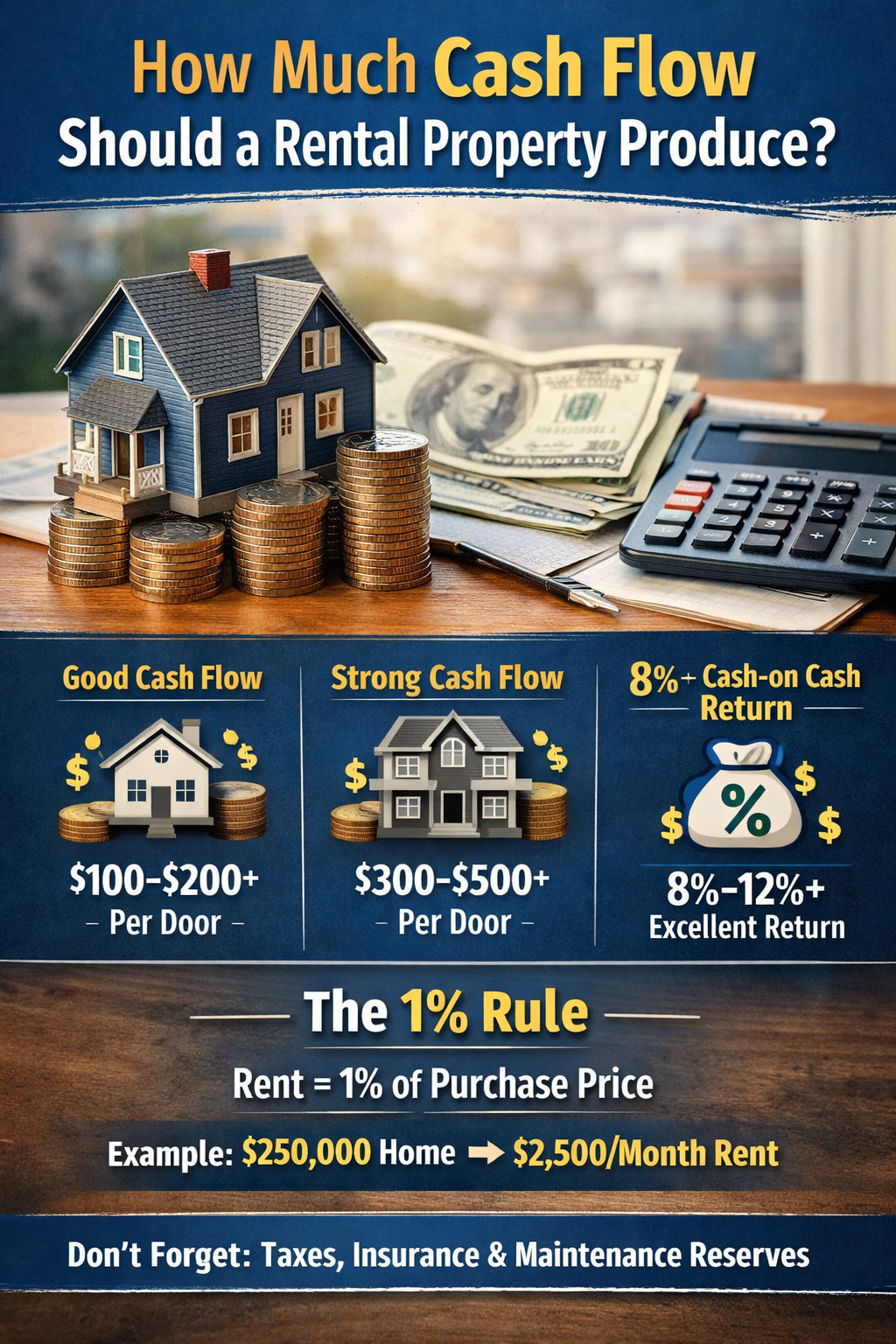
One of the most common questions from new and experienced real estate investors is: How much cash flow should a rental property actually produce? The answer depends on your investment goals, market conditions, financing, and risk tolerance. However, there are some benchmarks investors can use to evaluate whether a property is a good investment.
What Is Cash Flow?
Cash flow is the money left over after all expenses have been paid.
Cash Flow Formula:
Rental Income – Mortgage Payment – Taxes – Insurance – Maintenance – Vacancy Costs – Property Management Fees = Monthly Cash Flow
For example:
- Rent: $2,000/month
- Mortgage: $1,200/month
- Taxes & Insurance: $300/month
- Maintenance Reserve: $100/month
- Vacancy Reserve: $100/month
Monthly Cash Flow: $300
What's Considered Good Cash Flow?
Many investors use these general guidelines:
Minimum Goal: $100-$200 Per Door
Some investors won't purchase a rental property unless it produces at least $100-$200 per month in positive cash flow per unit.
Examples:
- Single-family home: $200/month
- Duplex: $400/month total
- Fourplex: $800/month total
While modest, these properties may still provide significant long-term wealth through appreciation and mortgage paydown.
Strong Cash Flow: $300-$500+ Per Door
Properties generating $300-$500 or more per unit each month are generally considered strong performers.
For example:
- Duplex producing $800/month total
- Fourplex producing $1,600/month total
These properties can provide meaningful monthly income while building equity.
Excellent Cash Flow: 8%+ Cash-on-Cash Return
Sophisticated investors often focus on cash-on-cash return rather than dollar amounts alone.
Cash-on-Cash Return=Annual Cash FlowCash Invested×100%\text{Cash-on-Cash Return} = \frac{\text{Annual Cash Flow}}{\text{Cash Invested}} \times 100\%
Generally:
- Under 5%: Weak
- 5%-8%: Average
- 8%-12%: Strong
- 12%+: Excellent
The 1% Rule
Many investors use the "1% Rule" as a quick screening tool.
A property should generate monthly rent equal to approximately 1% of the purchase price.
Example:
- Purchase Price: $250,000
- Target Rent: $2,500/month
While not a perfect metric, it helps investors quickly identify potentially profitable opportunities.
New Orleans Market Considerations
In the New Orleans area, cash flow expectations vary significantly by neighborhood.
Some areas offer:
- Lower purchase prices
- Higher rental yields
- Strong cash flow
Others offer:
- Higher appreciation potential
- Lower immediate cash flow
- Greater long-term equity growth
Investors often find stronger cash-flow opportunities in areas outside the historic core, while neighborhoods with high owner-occupancy demand may offer greater appreciation.
Don't Forget Hidden Expenses
Many new investors overestimate cash flow because they fail to account for:
- Vacancy periods
- Capital expenditures (roof, HVAC, water heater)
- Property management fees
- Repairs and maintenance
- Property taxes
- Insurance increases
- Flood insurance (particularly important in Louisiana)
A rental producing $500/month on paper may only average $250-$350/month after realistic reserves.
How Much Cash Flow Do You Need?
Your target depends on your goals:
| Goal | Recommended Monthly Cash Flow |
|---|---|
| Learning with first rental | $100-$200+ |
| Supplemental income | $300-$500+ |
| Replacing a job income | Portfolio producing $3,000-$10,000+/month |
| Financial independence | Expenses covered by total portfolio cash flow |
For example, if your monthly living expenses are $6,000, you'd need approximately $6,000 per month in net rental cash flow to cover them entirely.
Final Thoughts
A rental property doesn't need to generate massive cash flow to be a successful investment. Many investors build wealth through a combination of monthly income, property appreciation, mortgage paydown, and tax advantages.
As a rule of thumb, a rental property producing $200-$500+ per month in reliable positive cash flow while maintaining healthy reserves is often considered a solid investment. The best opportunities are those that provide both immediate income and long-term appreciation potential.
For investors in the New Orleans market, careful analysis of rents, insurance costs, taxes, and flood risk is essential to accurately project cash flow before making a purchase. Learn More
Check out this article next