

Are New Orleans Home Prices Rising or Falling? Why Average and Median Prices Tell Different Stories
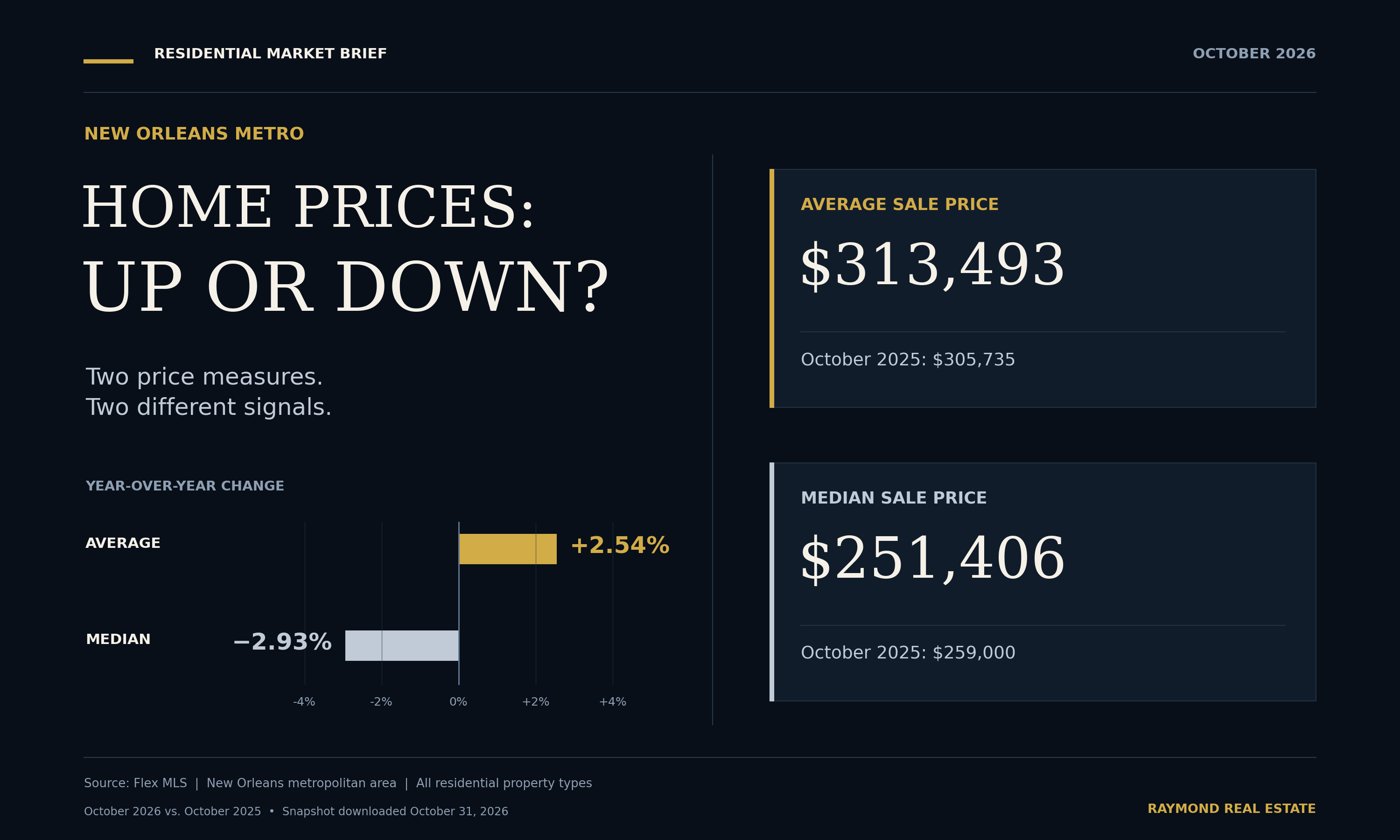
The October 2026 Flex MLS report for the New Orleans metropolitan area shows two different price signals: the average residential sale price increased year over year, while the median declined.
For a New Orleans homeowner thinking about selling, that can raise an understandable question: Is my property gaining value or losing it?
For a buyer, the question may be whether a lower median means there is more room to negotiate.
Average and median sale prices measure different things. Both can be accurate while moving in opposite directions, and neither establishes the value of an individual property.
Understanding that distinction helps you read a market report and make a more informed decision about your next move.
What the October New Orleans Metro Residential Report Shows
The Flex MLS Market Summary for the New Orleans metropolitan area, downloaded on October 31, 2026, covers all residential property types and reports the following comparisons:
| Sale-price measure | October 2025 | October 2026 | Year-over-year change |
|---|---|---|---|
| Average sale price | $305,735 | $313,493 | +2.54% |
| Median sale price | $259,000 | $251,406 | −2.93% |
Source: Flex MLS, New Orleans metropolitan area, all residential property types. Prices are rounded to whole dollars; percentage changes are as reported. October results reflect records available at the time of download and may be updated as transactions are reported.
Looking only at the average would suggest an increase. Looking only at the median would suggest a decline.
The useful next step is to understand what each number measures.
Average Versus Median: What Is the Difference?
The average sale price is the total dollar amount of the sales divided by the number of properties sold. A small number of expensive transactions can have a substantial effect on it.
The median sale price is the middle price when the sales are arranged from lowest to highest. When there is an even number of sales, it is the average of the two middle prices.
The National Association of REALTORS® explains that medians are less influenced by a relatively small share of high-priced sales than averages. However, a median still describes the properties that sold during the period.
For more context on interpreting broad market claims, read Don’t Let Home Prices Headlines Fool You.
How Can the Average Rise While the Median Falls?
Consider a simplified, hypothetical example involving three sales in each period.
In the first period, homes sell for $250,000, $300,000, and $350,000. The average and median are both $300,000.
In the next period, three different homes sell for $200,000, $275,000, and $500,000. The average rises to $325,000, while the median falls to $275,000.
The higher-priced sale lifts the average, while the middle transaction is lower.
This example shows how the mix of sales can affect both measures. It does not establish that sales mix caused the difference in the October report. That would require examining the underlying transactions.
A changing sale-price statistic can reflect changes in prices, changes in the properties being sold, or both.
Repeat-sales indexes address a different question. The Federal Housing Finance Agency explains that its house price indexes compare transactions on the same properties over time to help control for changes in the mix of homes represented. Even those indexes describe broader trends rather than setting a specific home’s asking price.
The Time Period Matters, Too
A single month and a year-to-date report can tell different stories.
In the same Flex MLS New Orleans metro report, the October median sale price declined 2.93% from October 2025. The reported year-to-date median, however, increased from $255,000 to $260,000, a gain of 1.96%.
Those figures describe different collections of transactions over different time windows.
Before drawing a conclusion, check whether a headline compares:
- One month with the same month a year earlier.
- One month with the immediately preceding month.
- Year-to-date results with the corresponding prior-year period.
- A city, parish, metro area, or a broader reporting region.
- All residential properties or a specific property type.
Keep the geography, property category, and time period consistent when making comparisons.
What This Means for New Orleans Homeowners
This Flex MLS report covers houses, condos, townhomes, and other residential property types across the New Orleans metropolitan area. Individual neighborhoods and property categories can perform differently from the combined market.
A renovated Uptown house, a Lakeview property needing major work, and a Warehouse District condo with association dues present different choices to buyers. A combined average cannot capture every difference.
For a property-specific valuation, focus on relevant recent sales and current competition. Consider location, property type, living area, layout, condition, parking, outdoor space, and significant updates.
For condos, also examine comparable buildings, monthly ownership costs, association finances, and restrictions that may affect a buyer’s plans. Our guide to evaluating condo associations explains questions worth investigating.
Our article on why online home values can miss important New Orleans property details offers another perspective on why a broad estimate deserves closer review.
What Sellers Should Do With This Information
Use market statistics to establish context, then build your pricing strategy around your actual competition.
Ask:
- Which recent sales most closely resemble my property?
- What comparable listings can buyers choose today?
- How do my condition, updates, parking, and location compare?
- What do showing activity, offers, and buyer feedback indicate?
A higher average sale price does not automatically support raising your asking price. Likewise, a lower median does not establish that your home should be reduced by the same percentage.
Preparation also belongs in the discussion. Our article on move-in-ready homes in New Orleans explores how condition and immediate ownership responsibilities can influence a buyer’s decision.
The goal is an asking price supported by the property, the relevant sales, and the choices available to buyers.
What Buyers Should Look At Before Making an Offer
A lower reported median can be a reason to investigate the market more closely. It does not tell you the appropriate discount on a particular listing.
Compare the asking price with relevant closed sales, evaluate the property’s condition, and review competing options. Consider days on market, price changes, and the terms that would make the purchase work for you.
Also estimate the full ownership cost: financing, taxes, insurance, maintenance, and any association dues or known assessments.
For condominium buyers, our New Orleans condo inventory guide explains why the building, price range, and competing units deserve attention alongside broader statistics.
An offer should reflect the property’s value and your circumstances, supported by the information available.
Frequently Asked Questions
Does a falling median mean every home is losing value?
No. The median describes the middle sale price within a particular group of transactions. Its change alone cannot show how each property’s value changed.
Is the average or median better for understanding home prices?
Both are useful. The median is less sensitive to unusually expensive transactions, while the average helps describe total sales dollars relative to transaction count. Use them alongside sales volume, inventory, property characteristics, and relevant comparable sales.
Should I adjust my home’s value by the reported percentage change?
A broad percentage is insufficient for that calculation. Review comparable properties and the conditions affecting your specific home before changing your price expectations.
Can condo prices behave differently from the overall residential market?
Yes. Condo-specific demand, building condition, association costs, financing considerations, and available inventory can produce a different picture from an all-residential report.
Find Out What the Market Means for Your Property
The practical question is what buyers are paying for homes like yours—or for the kind of property you want to buy.
At Raymond Real Estate, we help buyers and sellers connect market information with property-specific decisions throughout the New Orleans area.
Contact Raymond Real Estate to request a comparative market analysis or discuss your next purchase with a clearer understanding of the numbers.
Check out this article next