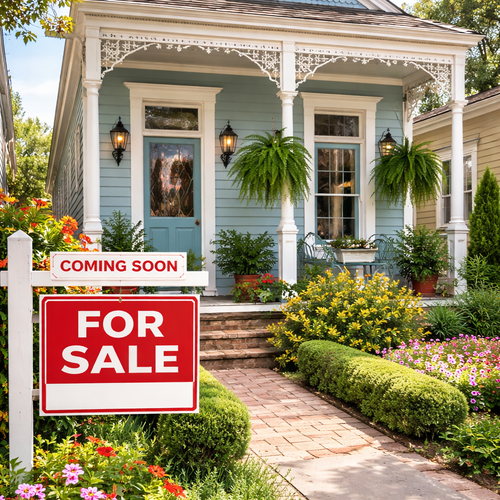


You can spot a New Orleans buyer from a mile away once the search gets serious. They stop asking for "a nice house" and start asking better questions. Is this block quiet after dark? Does the condo association have solid reserves? How much updating does that historic shotgun really need? A successful New Orleans property search is rarely about square footage alone. It is about reading the details that shape daily life and long-term value.
That is what makes this market so compelling and, at times, so demanding. New Orleans offers architectural character, deeply distinct neighborhoods, and housing stock that can shift dramatically from one street to the next. For buyers, that means the right home is not just a listing that looks good online. It is a property that fits your lifestyle, your timing, your budget, and your comfort level with the trade-offs that come with buying in a city this unique.
Why a New Orleans property search takes more strategy
In some markets, buyers can begin with broad filters and narrow down with relative ease. New Orleans does not always cooperate with that approach. The city rewards nuance. A beautifully renovated condo in the Warehouse District serves a very different buyer than a historic home in Uptown or a newer residence in Lakeview. Even when price points overlap, the ownership experience can be entirely different.
That is why search strategy matters from the beginning. If you start too broadly, everything can look promising for a week or two, then suddenly nothing feels right. If you start too narrowly, you can miss strong options in neighborhoods you had not fully considered. The best approach is focused, but not rigid.
Buyers also need to account for variables that do not always show up in listing photos. Insurance costs, flood zone considerations, parking, condo rules, renovation quality, and lot-to-lot differences all influence whether a property is truly a fit. In New Orleans, those details are not side issues. They are central to the decision.
Start with lifestyle, not just price
Price matters, of course. But if your search begins and ends with a number, you may spend months chasing homes that do not support how you actually want to live.
A better starting point is your daily routine. Do you want to walk to restaurants and neighborhood cafés, or do you prefer more space and a quieter residential feel? Are you comfortable with an older home that may need ongoing upkeep, or would you rather prioritize low-maintenance living in a condominium? Do you need off-street parking, guest space, a home office, or outdoor entertaining areas? These are not cosmetic preferences. They shape where your strongest options are likely to be.
For example, a buyer drawn to charm and historic detail may initially gravitate toward older homes in iconic neighborhoods. That can be a smart move, but it should come with clear eyes. Historic properties often offer beauty and character that newer construction cannot replicate, yet they may also require more maintenance and a greater tolerance for imperfect floor plans. On the other hand, a newer or recently renovated property may offer convenience and efficiency, but sometimes at the expense of architectural individuality.
Neither choice is better across the board. It depends on what kind of ownership experience you want.
Neighborhood fit is everything
A search in New Orleans is, in many ways, a neighborhood search. Buyers often come in with a short list of areas they know by name, but the most successful outcomes usually come from understanding how each neighborhood feels in practice, not just on paper.
The French Quarter, Garden District, Uptown, Mid-City, Lakeview, the Marigny, and the Warehouse District all carry distinct identities. So do many smaller pockets within them. Commute patterns, walkability, architectural consistency, nightlife exposure, and housing inventory can vary block by block.
That matters because a home that looks perfect online can feel entirely wrong once you experience the surrounding area at the right time of day. A street that feels peaceful on a weekday morning may be much livelier on a Friday evening. A condo building with strong appeal may have rules or fees that make it less practical for your goals. A highly desirable neighborhood may still have micro-locations that perform differently in terms of privacy, traffic, and resale strength.
Local guidance helps buyers separate broad reputation from actual fit. That is especially useful for relocation clients, first-time buyers, and anyone moving between neighborhoods for a different phase of life. Explore Areas
Search tools help, but they are not the whole answer
Online platforms are useful. They let buyers monitor price changes, compare photos, and get a feel for inventory. But digital search tools work best as a starting point, not a decision-making system.
Listings do not always tell the full story. Wide-angle photography can flatten proportions. Descriptions can emphasize charm while downplaying layout limitations. A property may appear turnkey, yet inspection findings or association documents reveal concerns that matter. In a condo purchase, for example, the building itself can be as important as the unit.
That is where a more curated search creates real value. When properties are filtered not only by budget and bedroom count, but also by neighborhood nuance, ownership costs, lifestyle fit, and resale potential, buyers save time and make stronger decisions. Raymond Real Estate approaches that process with the kind of local specificity that this market demands.
What to evaluate beyond the listing price
A disciplined New Orleans property search should always look past the asking price. Monthly ownership costs can shift the real picture quickly.
Insurance is one major factor. Depending on the property type, location, and condition, costs can vary significantly. Flood zone status matters too, though it should be interpreted carefully rather than emotionally. Condo buyers should review association dues, reserve health, building maintenance standards, and any pending assessments. Buyers considering older homes should pay close attention to roofs, foundations, HVAC systems, and evidence of quality renovation work.
There is also the question of resale. Even if you plan to stay for years, future marketability matters. Homes with strong location fundamentals, practical layouts, parking solutions, and well-executed updates often appeal to a broader pool of buyers later on. That does not mean every purchase should be conservative or generic. It simply means your search should balance personal taste with smart positioning.
Timing matters, but perfection is not the goal
Many buyers wait for the perfect moment to begin. They want rates to shift, inventory to improve, or the ideal listing to appear at exactly the right price. While timing always plays a role, waiting for perfect conditions can become its own form of indecision.
The better question is whether you are prepared to act when the right property appears. That means understanding your financing, knowing your preferred neighborhoods, and having a realistic sense of your must-haves versus your preferences. In competitive situations, clarity matters. Buyers who know where they can compromise tend to move with more confidence than those who are still trying to define the basics under pressure.
This is especially true in New Orleans, where standout properties can attract immediate attention while others linger for reasons worth investigating. Days on market alone do not tell the whole story. Sometimes a home is overlooked because of presentation, even though the fundamentals are excellent. Other times a beautiful listing has hidden constraints. Reading those signals requires context.
The best search is informed, not overwhelming
There is a difference between seeing everything and seeing what actually serves your goals. More listings do not automatically create better outcomes. Often, they create fatigue.
A strong property search should feel clear, not chaotic. You should know why certain homes make the cut and why others do not. You should understand the trade-offs between location and space, between historic charm and maintenance, between condo convenience and monthly dues. Most of all, you should feel that the process is narrowing toward the right decision rather than circling endlessly around possibilities.
That level of clarity comes from combining smart search technology with hands-on expertise. In a market as layered as New Orleans, buyers benefit from guidance that is polished, responsive, and grounded in the realities of the city - not just the headlines or the photos.
If you are beginning a New Orleans property search, the goal is not to look at more homes. It is to look at the right homes, ask better questions, and move forward with confidence when one truly fits. The right home often stands out most clearly when your search is guided by experience, not just enthusiasm. Learn More
Check out this article next